

Periodontist vs. Oral Surgeon vs. Endodontist: Who Does What

Periodontist vs. Oral Surgeon vs. Endodontist: A Full Guide
Your dentist handed you a referral, said the word "specialist," and you left without a clear picture of who you're about to see or why. That gap is more common than you'd think, and it matters, because these three specialties are not interchangeable. Each one focuses on a different part of your mouth, handles different problems, and gets involved at different points in your care.
- Periodontists treat your gums and the bone that holds your teeth in place, including periodontal therapy and gum disease treatment.
- Oral surgeons handle surgical work: extractions, wisdom teeth and other oral surgery, jaw and facial structure, grafting, and sedation.
- Endodontists treat the inside of the tooth, mainly the nerve and root canal system.
This guide walks through what each specialist does, when your case might involve more than one of them, and what to expect along the way.
To talk it through with a person, call us at (586) 238-3199 or request a consultation.
What This Guide Covers
Here's what's covered, in the order most people need it:
- Why dentistry splits into specialties, and how the training differs
- What each of the three specialties treats, and why your dentist refers you to each one
- Where orthodontists, prosthodontists, and your own general dentist fit in
- How a multi-specialty case gets sequenced, step by step
- What a specialist consultation and recovery look like
- How to judge a specialist's credentials when you can't evaluate their clinical skill directly
Why Dentistry Has Specialties at All (and How Training Differs)
Every dentist starts the same way: four years of dental school, earning either a DDS or DMD. Both degrees are equivalent, and at that point a dentist is licensed to perform most procedures, including extractions, root canals, and implants.
Some procedures, though, come up rarely in general practice or carry a higher risk of serious complications. For those, repetition and focused training genuinely change the outcome. A specialist picks one narrow area and spends years doing almost nothing else, under supervision, before seeing patients independently. Residency lengths give you a sense of how deep that training goes:
- Periodontics: roughly three additional years, focused on gums, bone, and implant placement.
- Endodontics: two to three additional years on the inner tooth, root anatomy, and surgical root treatment.
- Oral and maxillofacial surgery: four to six additional years, hospital-based, with anesthesia training and rotations in general surgery and medicine.
- Orthodontics and prosthodontics: generally two to three additional years each.
What a Periodontist Treats (and When You Need One)
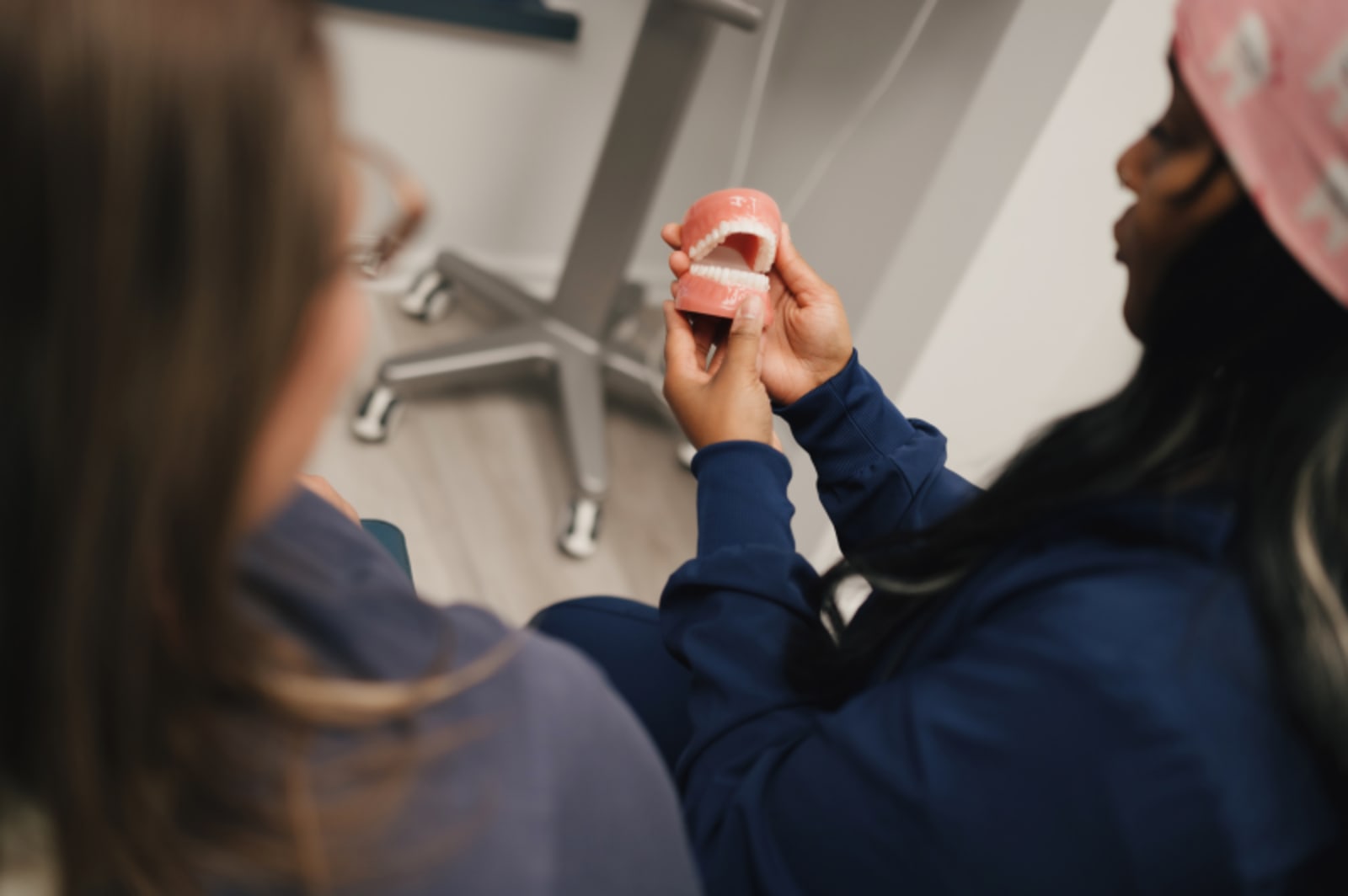
If your gums bleed, recede, or have started pulling away from your teeth, or if you've been told you've lost bone around a tooth, a periodontist is usually the specialist you'll meet. Periodontics focuses on the structures that hold your teeth in place: the gum tissue, the bone underneath, and the fibers connecting them. When that foundation weakens, everything above it is at risk, including any implant you might want later. Common procedures include:
- Scaling and root planing, a thorough deep cleaning that removes bacterial buildup from below the gumline and smooths root surfaces so the tissue can reattach.
- Osseous surgery, reshaping bone that infection has damaged so that deep gum pockets can be reduced.
- Guided tissue regeneration and bone grafting, procedures that encourage new bone and gum tissue to grow back in areas where it has been lost.
- Gum grafting, adding tissue to cover roots that have become exposed due to recession.
- Crown lengthening, adjusting gum and bone levels so enough tooth structure is visible for a crown to fit securely.
- Laser therapy, treating infected gum tissue with less cutting and suturing than traditional surgery, where appropriate.
Once your gum pockets stop improving with regular cleanings, the problem has moved beyond hygiene into something more structural. Gum disease is also closely linked to conditions like diabetes and heart disease, so a periodontist will ask about your overall health, not just your teeth. If you have a history of gum disease and are considering implants, getting the gums stable first is not a delay tactic. It is what makes the result last.
What an Oral Surgeon Does That Other Specialists Don't
Oral and maxillofacial surgery covers surgical treatment of the mouth, jaws, and face. It has the widest scope of any dental specialty. Two things set it apart from other specialties: the range of the work, which extends to the jawbone, sinuses, and nerves of the lower jaw, and anesthesia. Oral surgeons are trained to give IV sedation and general anesthesia in an office setting, which is why cases needing deeper sedation go to them rather than another specialist.
Typical work includes:
- Impacted wisdom teeth, including teeth lying sideways or sitting close to the nerve canal
- Complex or surgical extractions, broken roots, and teeth that failed a previous attempt
- Bone grafting, ridge augmentation, and socket preservation after an extraction
- Sinus lifts, when the upper jaw lacks enough vertical bone for an implant
- Implant placement, particularly where reconstruction comes first
- Orthognathic surgery, which corrects jaw alignment when the upper and lower jaws don't meet properly
- Facial trauma, cysts, and oral pathology, including any lesion, ulcer, or lump that hasn't resolved in two weeks
What an Endodontist Focuses On

Inside every tooth is a soft core called the pulp, which contains the nerve and blood supply. When that pulp becomes inflamed or infected, whether from deep decay, a crack, a knock to the mouth, or an old procedure that didn't fully clear the problem, an endodontist is trained to treat it while keeping the tooth.
They handle the more complex versions of procedures your general dentist may do routinely:
- Root canal treatment, especially on molars with several canals, curved roots, or canals that have narrowed over time
- Retreatment, reopening a tooth whose earlier root canal didn't fully work and addressing what was missed
- Apicoectomy, a minor surgery that removes the very tip of the root and seals it when infection keeps coming back there
- Traumatic injury care, including teeth knocked loose or out
- Diagnosing hard-to-locate pain, the kind where you can point to a general area but not a specific tooth
Every case comes down to one honest question: is this tooth worth saving, and will it hold up once treated? A good endodontist will answer that plainly, including when the answer is no.
How Do These Specialties Overlap With Orthodontists, Prosthodontists, and Your General Dentist?
The three specialties above are the ones most patients get referred to for surgical or infection-related problems, but they're not the whole field.
Orthodontists
Orthodontists move teeth and correct bites with braces, clear aligners, and appliances. Teeth can be moved to open space for an implant, uprighted before a crown, or aligned in coordination with jaw surgery.
Prosthodontists
Prosthodontists replace and restore teeth, including crowns, bridges, dentures, and the visible teeth that attach to implants. On a full-arch case, a prosthodontist often designs the final result first, and the surgical plan is built around that design. In many cases a restorative general dentist fills this role instead.
Pediatric Dentists, Oral Pathologists, and Others
Other recognized specialties include pediatric dentistry, oral and maxillofacial pathology and radiology, dental public health, and dental anesthesiology. You're less likely to be referred to these directly, though a pathologist may review a biopsy sample taken by your oral surgeon without ever meeting you.
Where Your General Dentist Sits
Your general dentist is the hub, not a lower rung. They see you regularly, catch changes early, hold the long-term picture of your mouth, and decide when a problem calls for specialist training. They also handle much of the restorative work at the end, including the crown that goes on an implant. Specialty care works best as a loop that returns to them.
How These Specialists Work Together on the Same Case
Simple problems stay with one provider. Complex ones become a chain, where what one specialist finds shapes what the next one can do. Here's a common example: a tooth with a failing root canal and bone loss around it.
1. The Endodontist Decides Whether the Tooth Is Worth Saving
Retreatment gets evaluated first, using 3D imaging to look for fractures, missed canals, and the extent of infection. If the tooth can be saved, the plan may end here.
2. The Periodontist Checks the Surrounding Gum and Bone
If removal is on the table, the gum and bone around the tooth determine what's possible afterward. Thin tissue and damaged jawbone affect the next steps, and it's better to know that before the tooth comes out.
3. Extraction and Grafting
The tooth is removed, and where bone is thin, graft material holds the space while your own bone grows into and around it. The site then heals, typically for several months.
4. Implant Placement
Once the foundation is ready, the implant goes in, positioned to work for the final crown rather than just the available bone. It then bonds with the bone over a healing period.
5. The Final Crown
The crown gets designed and fitted, often by your own general dentist, and the case closes back where it started.
What makes or breaks that sequence is shared records and agreed timing. Each step has to be scheduled around the healing the previous one requires.
Why Your General Dentist Referred You to a Specialist
A referral can feel like a warning sign, and some people wonder whether their dentist is just sending business to a friend. Usually it is neither. Dentistry is organized this way on purpose: your general dentist manages the whole picture and brings in a specialist when a case calls for focused training. Sending a difficult case out is a sign of good judgment.
The most common reasons for each referral:
- To a periodontist: gum pockets that haven't improved with regular cleanings, bone loss showing on x-rays, gums pulling away from teeth, loose teeth, or implant planning in a patient with a history of gum disease.
- To an oral surgeon: impacted wisdom teeth, roots sitting close to a nerve or sinus, a tooth likely to break during removal, a need for bone grafting, a suspicious lesion, or a patient who needs IV sedation.
- To an endodontist: pain that can't be pinpointed to one tooth, a root canal that didn't fully resolve the problem, complex root anatomy that's hard to navigate, or a tooth injured in an accident.
Before you leave the specialist, ask what report and imaging your dentist will receive so everyone stays on the same page for whatever comes next.
How to Evaluate a Specialist's Qualifications and Experience
You can't watch someone operate before choosing them. But there's plenty you can look into before you ever sit in the chair.
Credentials You Can Verify
Ask where a specialist trained, how long their residency was, and whether they're board certified. Any good specialist will answer those questions without hesitating. Our team includes Dr. Whitney D. Weiner, DDS, MS, who is board certified in periodontics and dental implants; Dr. Colonya Calhoun, DDS, PhD, our oral and maxillofacial surgeon with a PhD in oral biology from UCLA; Dr. Mustafa Tattan, DDS, MS, who specializes in periodontics and dental implants; and Dr. David Karwacki, DDS. You can read more about each of them on our meet the team page.
Experience With Your Specific Procedure
General experience matters less than experience with your exact situation. A sinus lift, a full-arch reconstruction, a root canal retreatment, and a failed implant are each their own skill set. A specialist who performs your procedure regularly has seen the ways it can go wrong and can walk you through them without hesitating.
Technology and Planning
Ask what imaging they use and whether the surgery is digitally guided. 3D computer-guided planning and laser therapy for gum treatment, both of which we use, allow for more precise placement and often a gentler experience. Then ask the more important follow-up: how does that imaging actually change the treatment plan?
Outside Signals Worth Checking
Patient reviews on established platforms, a strong reputation among local referring dentists, teaching involvement, and community recognition all tell you something. Ours includes a Macomb County "Best of 2026" win and an active study club we host for area dentists.
How Consent Is Handled
Sometimes surgery turns up something the imaging didn't catch, and a decision has to be made. Before you're sedated, you should know which calls the surgeon handles in the moment and which ones mean pausing to talk with you first. A practice that has thought this through will explain it clearly before anything begins.
Frequently Asked Questions
What exactly is my diagnosis, and what are all my options?
Ask your specialist to walk through every option, including the ones they did not recommend, and why each was included or ruled out. You should leave with a clear picture, not just a treatment plan.
What Happens if I Wait?
Some conditions are stable and can be monitored. Infection, active bone loss, and progressive gum disease are not. Ask what is likely to change in three months and in a year if you do nothing.
How Often Do You Perform This Procedure?
Experience with your specific procedure matters more than general experience. Also ask about risks that apply to your situation specifically, since factors like nerve proximity, sinus location, and bone quality vary from patient to patient.
Will Other Specialists Be Involved, and in What Order?
If your case involves more than one provider, get the full sequence and expected timeline before anything starts. Ask how handoffs between specialists will be handled so nothing falls through the cracks.
What Happens if You Find Something Unexpected During My Appointment?
Ask what is planned for each visit and what decisions might need to be made on the spot. If you will be sedated, you should know in advance which calls the surgeon handles in the moment and which ones wait for you to weigh in.
What Does Recovery Actually Look Like?
Ask about time off work, food restrictions, activity limits, pain management, and which symptoms are normal versus worth a call. Recovery looks different depending on the procedure, so get specifics rather than general reassurance.
How Will My General Dentist Be Kept in the Loop?
Ask what report and imaging your dentist will receive after your visit, and who is responsible for the final restoration. Specialty care works best when it loops back to the dentist who knows your full history.
How Lakeshore Dental Specialists Coordinates Multi-Specialty Care Under One Roof

The hardest part of complex dental care usually isn't any single procedure. It's the handoffs. Records that don't arrive, timing nobody owns, two providers who never actually spoke. Our Eastpointe office keeps everything in one chart, so you're never repeating yourself and nothing falls through the cracks.
Board-certified specialists in periodontics, oral surgery, endodontics, and implants work alongside orthodontic care in the same building:
- Treatment is planned together in person before anything starts, instead of pieced together from voicemails.
- If something changes mid-treatment, another specialist can step in without sending you somewhere new.
- When we place an implant, we coordinate with your own general dentist for the final crown.
- You can be seen with or without a referral, and referring dentists get their patients back with a clear report.
If you're holding a referral slip you don't fully understand, or making a decision you can't afford to get wrong, call Dr. Weiner, Dr. Calhoun, and the team at (586) 238-3199. We'll help you figure out which specialist you need and the right order of steps for your situation.
WE CAN’T WAIT TO MEET YOU
Call (586) 777-0260 or request an appointment online to set up your first visit. We’ll be in touch soon.